Landscape lighting
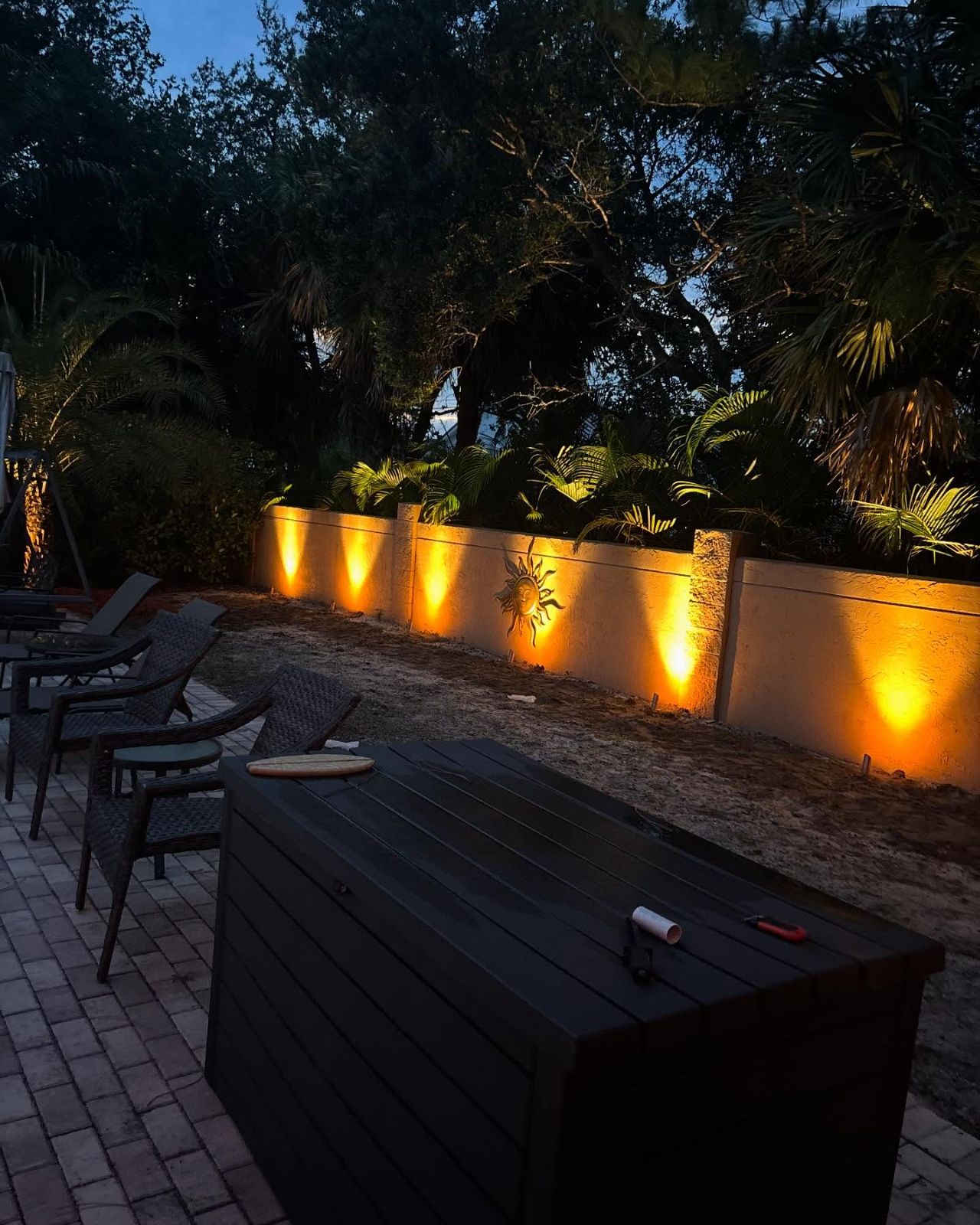
Done well, landscape lighting is the highest-impact thing you can do to the outside of a Florida house. Uplit palms, a lit path to the front door, and the back of the property given some depth after dark. Done badly, it's a row of identical fixtures aimed at nothing that turns green and dies in three seasons.
Low-voltage, from a properly fed transformer
Landscape lighting runs at 12 volts off a transformer, which is what makes it safe around kids, pets and a shovel. The transformer itself is line voltage and needs a correctly sized, GFCI-protected outdoor circuit to feed it, sized with headroom so you can add fixtures later without replacing it. Runs get planned so the fixtures at the end of a long run aren't noticeably dimmer than the ones near the transformer — voltage drop is the difference between a system that looks even and one that doesn't.
Fixtures chosen for the coast
This matters more here than almost anywhere. Cheap aluminum and thin plated fixtures corrode fast in Treasure Coast salt air — faster still on the barrier islands and anywhere near the Intracoastal. Solid brass and copper cost more up front and are still there, and looking better, a decade later. Ken would rather install fewer good fixtures than a yard full of ones you'll be replacing.
Uplighting palms, paths and zones
Palms take well-placed uplights; a royal or a mature sabal is the best subject on most properties here. Path lighting works when it's spaced to guide rather than to line the walk like runway markers. Splitting the system into zones on a timer or photocell — front on at dusk, back on a switch — is what keeps it usable day to day.
Why a licensed electrician for landscape lighting
The 12-volt side is gentle. Everything feeding it isn't, and it all lives outdoors, in the rain, in sandy soil, in salt air.
- The line-voltage circuit feeding the transformer is GFCI-protected and rated for wet locations
- Burial depth and cable type done to code, so a future shovel or a landscaper's edger isn't a hazard
- Transformer sized with capacity to grow instead of running at its limit from day one
- Connections made to survive moisture — the usual failure point in a DIY kit
EC13011489 Licensed & Insured · Commercial & Residential · BBB Accredited Business
Send a couple of photos of the front of the house, ideally at dusk.
24/7 Emergency Service — if it's urgent, don't fill in a form. Call (772) 678-9583.
Got it — Ken will get back to you.
Emergency? Call now: (772) 678-9583